Creating an alias in Yandex DataLens

To add an alias for a pair of widgets:
Warning
If you use the new DataLens object model with workbooks and collections:
- In the left-hand panel, select Collections and workbooks.
- Open the workbook you need and select an object.
Proceed with this guide from Step 2.
-
In the left-hand panel, click Dashboards and select the dashboard you need. If you do not have a dashboard, create one.
-
At the top of the page, click Edit.
-
To the right of the widget to add a link for, click .
-
Select a link type in the list for the widget you are going to link.
-
In the window that opens, for both widgets, select from the list the fields for which you are creating the alias. The fields must be of the same type.
-
Click .
-
Click Apply.
Warning
Please note that you cannot create aliases for fields from the same dataset or fields with the same IDs from different datasets.
-
At the bottom of the Links window, click Apply.
-
-
In the top-right corner of the dashboard, click Save.
Example of creating a link
A chart named tutorial — Line chart is based on the tutorial dataset and a chart named tutorial 2 — Table is based on the tutorial 2 dataset.
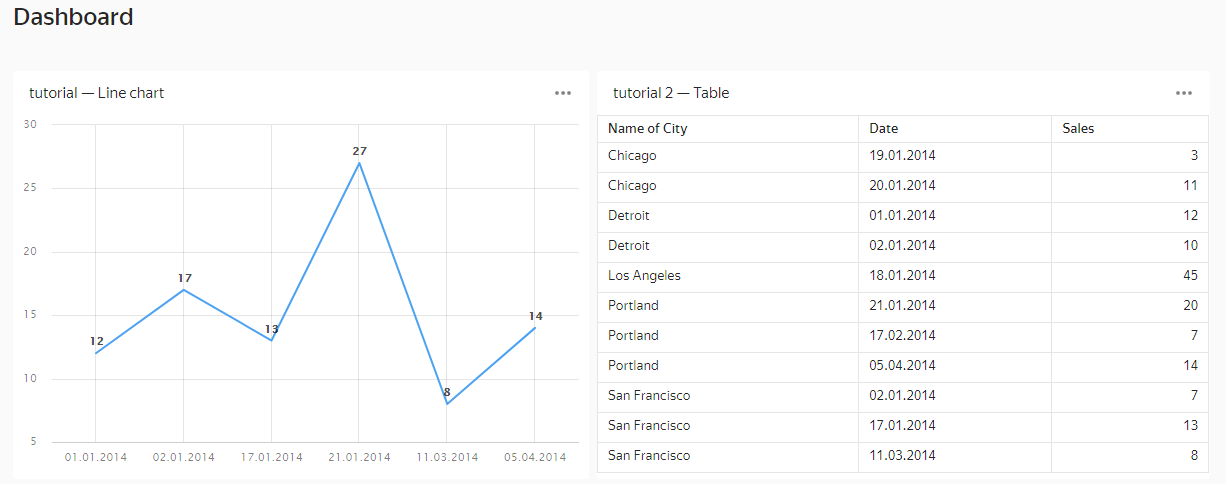
-
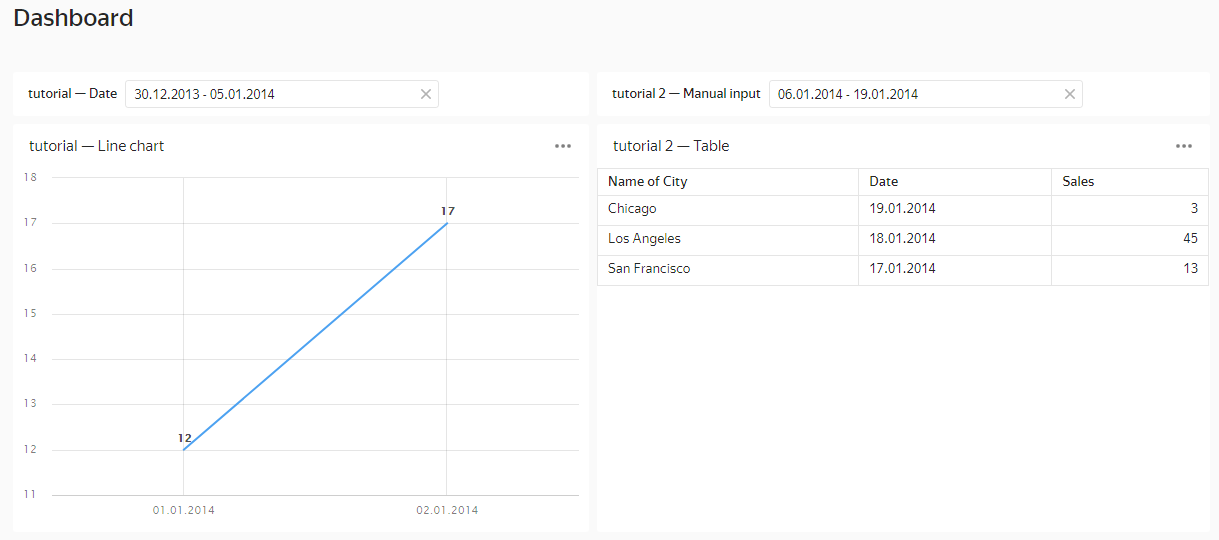
Let's add a tutorial — Date selector of the Based on dataset type to the dashboard. In the selector parameters, select the
tutorialdataset and theDatefield. A link between the selector and the tutorial — Line chart will be created automatically, since they are based on the same dataset. -
Let's add a tutorial 2 — Manual input selector of the Manual input type to the dashboard. In the selector parameters, select the Calendar element type and the
Datefield. -
Let's create a link between the tutorial 2 — Manual input selector and the tutorial 2 — Table chart using an alias. When creating an alias, select the
Datefield in the selector and theDate 2field in thetutorial 2dataset.As a result, the tutorial — Date selector will filter the tutorial — Line chart, and the tutorial 2 — Manual input selector will filter the tutorial 2 — Table chart.
-
Let's create a link between the tutorial 2 — Manual input selector and the tutorial 2 — Line chart using an alias. When creating an alias, select the
Datefield in the selector and theDatefield in thetutorialdataset.
Creating a link between the tutorial 2 — Manual input selector and the tutorial — Line chart links the tutorial 2 — Manual input and tutorial — Date selectors. This happens because the tutorial — Line chart and the tutorial — Date selector are based on the same dataset. As a result, any selector causes the appropriate values to be set automatically in the other selector and both charts' filters. To unlink the selectors, set their link type to Not linked.
When adding an alias, make sure the field the selector uses for filtering is included in the dataset used to build the chart. Otherwise, the link will not work.