Yandex Cloud
Search
Discuss with expertTry it for free
  • Customer Stories
  • Documentation
  • Blog
  • All Services
    • Cloud Interconnect
    • Cloud Backup
    • Cloud Registry
    • Yandex AI Studio
    • Compute Cloud
    • Object Storage
    • Managed Service for Kubernetes®
    • Yandex BareMetal
    • Smart Web Security
    • Security Deck
    • Managed Service for PostgreSQL
    • Managed Service for ClickHouse®
    • Monium
    • Cloud CDN
    • Network Load Balancer
    • Virtual Private Cloud
    • Cloud DNS
    • Application Load Balancer
    • Yandex Cloud Video
    • Stackland
    • Yandex Cloud Router
    • Yandex Managed Service for Trino
    • Managed Service for MySQL®
    • Managed Service for Valkey™
    • Managed Service for Apache Spark™
    • Yandex StoreDoc
    • Managed Service for OpenSearch
    • Managed Service for Apache Kafka®
    • Data Transfer
    • Yandex MPP Analytics Engine for PostgreSQL
    • Yandex Managed Service for Apache Airflow®
    • Data Processing
    • Yandex MetaData Hub
    • Managed Service for YDB
    • Managed Service for Sharded PostgreSQL
    • Managed Service for YTsaurus
    • Yandex WebSQL
    • DataLens
    • Yandex Search API
    • SpeechSense
    • SpeechKit
    • DataSphere
    • Vision OCR
    • Translate
    • Yandex Identity Hub
    • Key Management Service
    • Certificate Manager
    • Yandex Lockbox
    • Audit Trails
    • SmartCaptcha
    • Cloud Desktop
    • SourceCraft Code Assistant
    • Container Registry
    • Managed Service for GitLab
    • Managed Service for Prometheus®
    • Cloud Functions
    • API Gateway
    • Yandex Cloud Postbox
    • Message Queue
    • Serverless Integrations
    • IoT Core
    • Data Streams
    • Serverless Containers
    • Cloud Notification Service
    • Yandex Query
    • Identity and Access Management
    • Yandex Cloud Console
    • Resource Manager
    • Yandex Cloud Billing
    • Yandex Cloud Quota Manager
    • Cloud Apps
  • System Status
  • Marketplace
    • Featured
    • Infrastructure & Network
    • Data Platform
    • AI for business
    • Security
    • DevOps tools
    • Serverless
    • Monitoring & Resources
  • All Solutions
    • By industry
    • By use case
    • Economics and Pricing
    • Security
    • Technical Support
    • Start testing with double trial credits
    • Cloud credits to scale your IT product
    • Gateway to Russia
    • Cloud for Startups
    • Center for Technologies and Society
    • Yandex Cloud Partner program
    • Price calculator
    • Pricing plans
  • Customer Stories
  • Documentation
  • Blog
© 2026 Direct Cursus Technology L.L.C.
Yandex DataLens
  • DataLens neuroanalyst
    • Overview
    • Versioning
    • Caching
    • Combining data
    • Adding connection info
      • Creating a ClickHouse® connection
      • Creating a PostgreSQL connection
      • Creating a MySQL® connection
      • Creating a YDB connection
      • Creating a Greenplum® connection
      • Creating a SQL Server connection
      • Creating an Oracle Database connection
      • Creating a StarRocks connection
      • Creating a Prometheus connection
      • Creating a Snowflake connection
      • Creating a Trino connection
  • Gallery in DataLens
  • Audit Trails events
  1. Connections
  2. Databases
  3. Creating a SQL Server connection

Creating a connection to SQL Server in Yandex DataLens

Written by
Yandex Cloud
Updated at July 17, 2026
View in Markdown

Warning

Yandex Cloud holds no responsibility for configuring a remote connection on an external database server side. When connecting an external database that is not a Yandex Cloud resource:

  • Make sure the database uses an SSL certificate signed by a SSL certificate authority. You will not be able to create a connection in DataLens if the database uses a self-signed SSL certificate.

  • Grant database access to the following DataLens IP ranges (/ is followed by the subnet mask length):

    ipv4
    ipv6
    • 178.154.242.176/28
    • 178.154.242.192/28
    • 178.154.242.208/28
    • 178.154.242.128/28
    • 178.154.242.144/28
    • 178.154.242.160/28
    • 130.193.60.0/28
    • 2a02:6b8:c03:500:0:f83d:a987:0/112
    • 2a02:6b8:c02:900:0:f83d:a987:0/112
    • 2a02:6b8:c0e:500:0:f83d:a987:0/112
    • 2a02:6b8:c41:1300:0:f83d:a987:0/112

To create an SQL Server connection:

  1. Open the connection creation page.

  2. Under Databases, select the MS SQL Server connection.

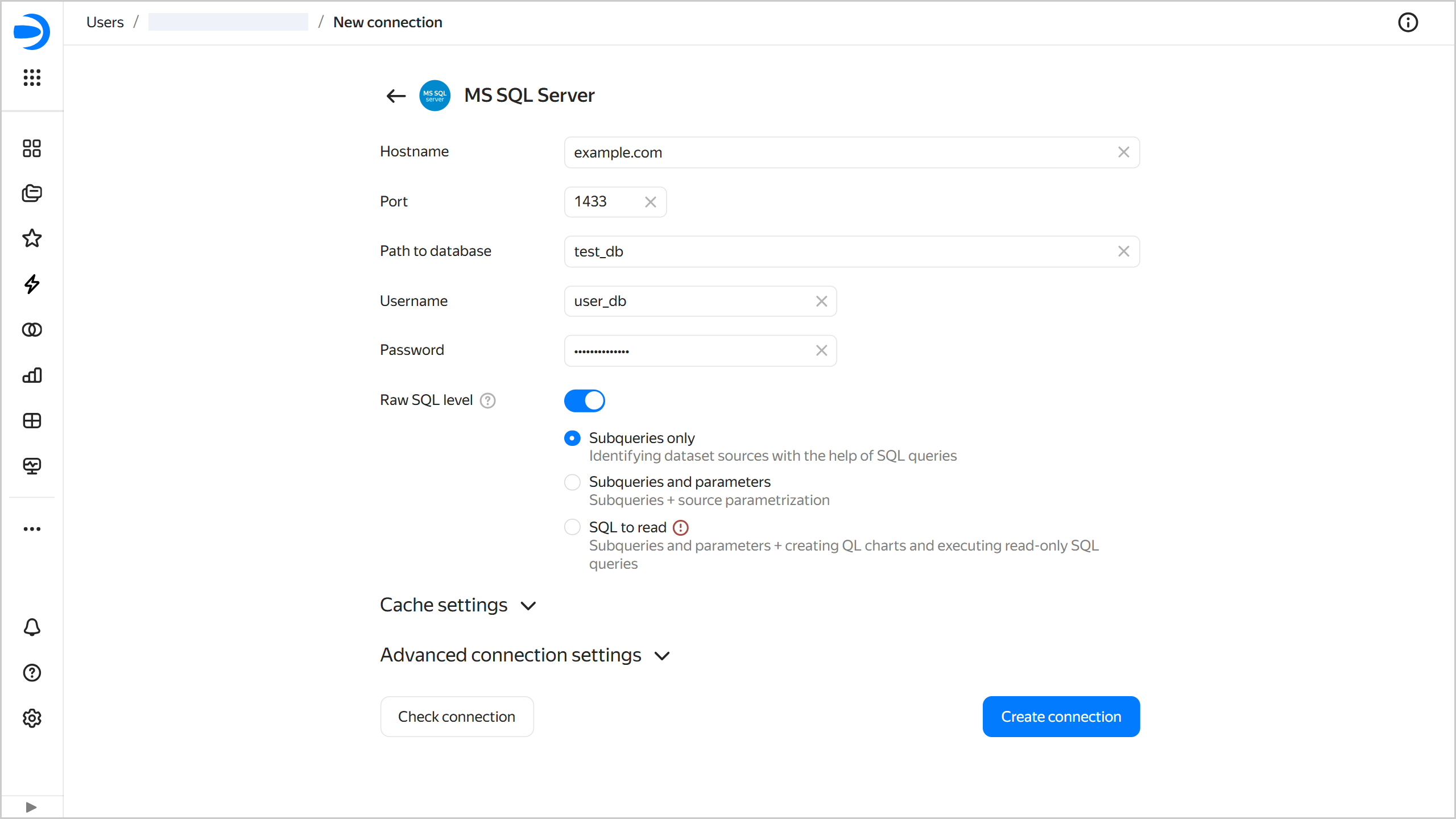
  3. Configure the connection as follows:

    • Host name: Specify the path to a master host or a SQL Server master host IP address. You can specify multiple hosts in a comma-separated list. If you fail to connect to the first host, DataLens will select the next one from the list.
    • Port: Specify the SQL Server connection port. The default port is 1433.
    • Path to database: Specify the database name.
    • Username: Specify a username for the SQL Server connection.
    • Password: Enter the password for the specified user.
    • Cache TTL in seconds: Specify cache TTL or leave the default value. The recommended value is 300 seconds (5 minutes).
    • Raw SQL level: Enables you to use an ad-hoc SQL query to generate a dataset. This option is disabled by default. When enabling it, you will need to select the raw SQL level:

      • Subqueries only: Describe dataset sources using SQL queries.
      • Subqueries and parameters: Describe dataset sources using SQL queries and use source parameterization.
      • SQL to read: Describe dataset sources using SQL queries, use source parameterization, and create QL charts.
  4. Optionally, test the connection by clicking Check connection.

  5. Click Create connection.

  6. Select a workbook to save your connection to or create a new one. If using legacy folder navigation, select a folder to save the connection to. Click Create.

  7. Enter a name for the connection and click Create.

Additional settingsAdditional settings

You can limit data export from charts by enabling the Disable data export option under Advanced connection settings. Thus, for charts based on the respective connection, the export data option will not be available in their menu. However, you will still be able to copy chart data and take screenshots.

Was the article helpful?

Previous
Creating a Greenplum® connection
Next
Creating an Oracle Database connection
© 2026 Direct Cursus Technology L.L.C.