
Yandex Cloud
Search
Discuss with expertTry it for free
  • Customer Stories
  • Documentation
  • Blog
  • All Services
    • Cloud Interconnect
    • Cloud Backup
    • Cloud Registry
    • Yandex AI Studio
    • Compute Cloud
    • Object Storage
    • Managed Service for Kubernetes®
    • Yandex BareMetal
    • Smart Web Security
    • Security Deck
    • Managed Service for PostgreSQL
    • Managed Service for ClickHouse®
    • Monium
    • Cloud CDN
    • Network Load Balancer
    • Virtual Private Cloud
    • Cloud DNS
    • Application Load Balancer
    • Yandex Cloud Video
    • Stackland
    • Yandex Cloud Router
    • Yandex Managed Service for Trino
    • Managed Service for MySQL®
    • Managed Service for Valkey™
    • Managed Service for Apache Spark™
    • Yandex StoreDoc
    • Managed Service for OpenSearch
    • Managed Service for Apache Kafka®
    • Data Transfer
    • Yandex MPP Analytics Engine for PostgreSQL
    • Yandex Managed Service for Apache Airflow®
    • Data Processing
    • Yandex MetaData Hub
    • Managed Service for YDB
    • Managed Service for Sharded PostgreSQL
    • Managed Service for YTsaurus
    • Yandex WebSQL
    • DataLens
    • Yandex Search API
    • SpeechSense
    • SpeechKit
    • DataSphere
    • Vision OCR
    • Translate
    • Yandex Identity Hub
    • Key Management Service
    • Certificate Manager
    • Yandex Lockbox
    • Audit Trails
    • SmartCaptcha
    • Cloud Desktop
    • SourceCraft Code Assistant
    • Container Registry
    • Managed Service for GitLab
    • Managed Service for Prometheus®
    • Cloud Functions
    • API Gateway
    • Yandex Cloud Postbox
    • Message Queue
    • Serverless Integrations
    • IoT Core
    • Data Streams
    • Serverless Containers
    • Cloud Notification Service
    • Yandex Query
    • Identity and Access Management
    • Yandex Cloud Console
    • Resource Manager
    • Yandex Cloud Billing
    • Yandex Cloud Quota Manager
    • Cloud Apps
  • System Status
  • Marketplace
    • Featured
    • Infrastructure & Network
    • Data Platform
    • AI for business
    • Security
    • DevOps tools
    • Serverless
    • Monitoring & Resources
  • All Solutions
    • By industry
    • By use case
    • Economics and Pricing
    • Security
    • Technical Support
    • Start testing with double trial credits
    • Cloud credits to scale your IT product
    • Gateway to Russia
    • Cloud for Startups
    • Center for Technologies and Society
    • Yandex Cloud Partner program
    • Price calculator
    • Pricing plans
  • Customer Stories
  • Documentation
  • Blog
© 2026 Direct Cursus Technology L.L.C.
Yandex DataLens
  • DataLens neuroanalyst
    • Overview
    • Seats
    • Users
    • Service plans and payment
    • Appearance
    • Security
    • Navigation
  • Gallery in DataLens
  • Audit Trails events
  1. Service settings
  2. Users

Users

Written by
Yandex Cloud
Updated at June 2, 2026
View in Markdown

There are several ways to add a user to DataLens:

  1. Via DataLens: If the user is not planning to use other Yandex Cloud services. This method allows you to invite users with a Yandex account. If the user asks for other Yandex Cloud services later on, you can assign them an additional role in the organization with the current DataLens instance.

  2. Via Yandex Identity Hub: If the user is planning to use other Yandex Cloud services. In which case you can invite to the organization Yandex account users or add federated and local users.

Note

Users can be added or invited by the organization administrator (the organization-manager.admin role) or owner (the organization-manager.organizations.owner role).

Adding a user via DataLensAdding a user via DataLens

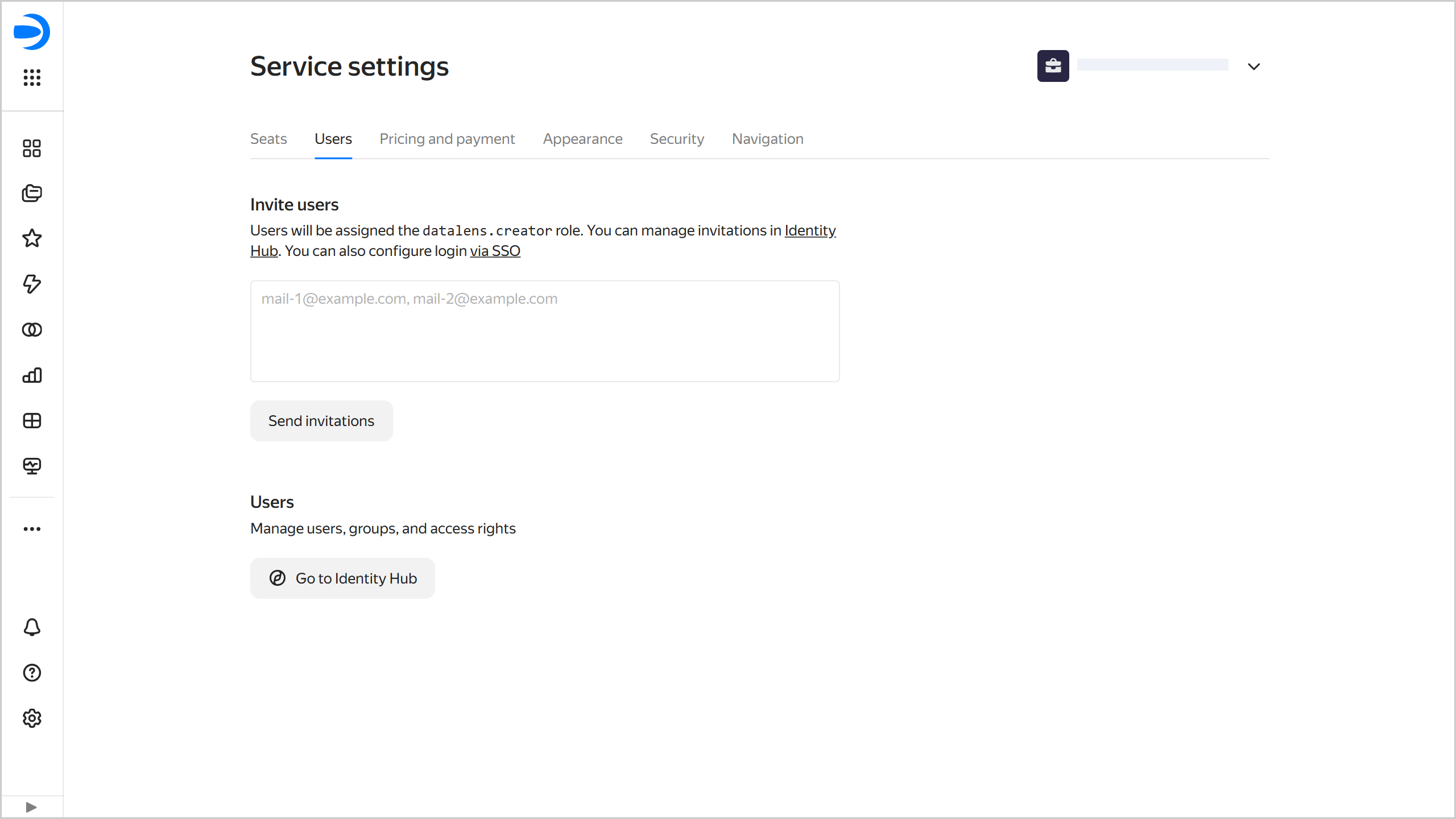
To add a user in DataLens:

  1. Go to the DataLens home page.
  2. In the navigation panel on the left, click to open settings.
  3. Under User management, click Invite users.
  4. Enter the email addresses of the users you want to invite, e.g., login@yandex.com.
  5. Click Send invitations.

The user will receive a DataLens invitation email. Once the user accepts the invitation and selects the account for login, they can log in to your organization. The user will get the datalens.creator role in the organization with the current DataLens instance. To log in to DataLens, the user will need a seat.
image

Adding a user via Yandex Identity HubAdding a user via Yandex Identity Hub

Inviting a user with a Yandex accountInviting a user with a Yandex account

To invite a user with a Yandex account, follow this guide from the Yandex Identity Hub documentation.

Warning

Users can only use DataLens if they have a role that enables access to the service. To ensure they have access, wait for them to accept the invitation to your organization and assign them the datalens.visitor role.

Adding a federated userAdding a federated user

If you set up an identity federation, follow this guide to add a new federated user. After that, make sure to assign them the datalens.visitor role.

A federated user can go directly to the dashboard of their choice by authenticating via a link in the following format:

https://datalens.ru/<dashboard_ID>?__yc_federation_id=<federation_ID>

Was the article helpful?

Previous
Seats
Next
Service plans and payment
© 2026 Direct Cursus Technology L.L.C.