Creating an API Connector connection

With API Connector in Yandex DataLens, you can send HTTP requests to any API on the internet. You can use such a connection only in Editor as it is not supported in QL charts or dataset-based charts.
To create an API Connector connection, follow these steps:
-
Open the new connection creation page.
-
Under Files and services, select API Connector.
-
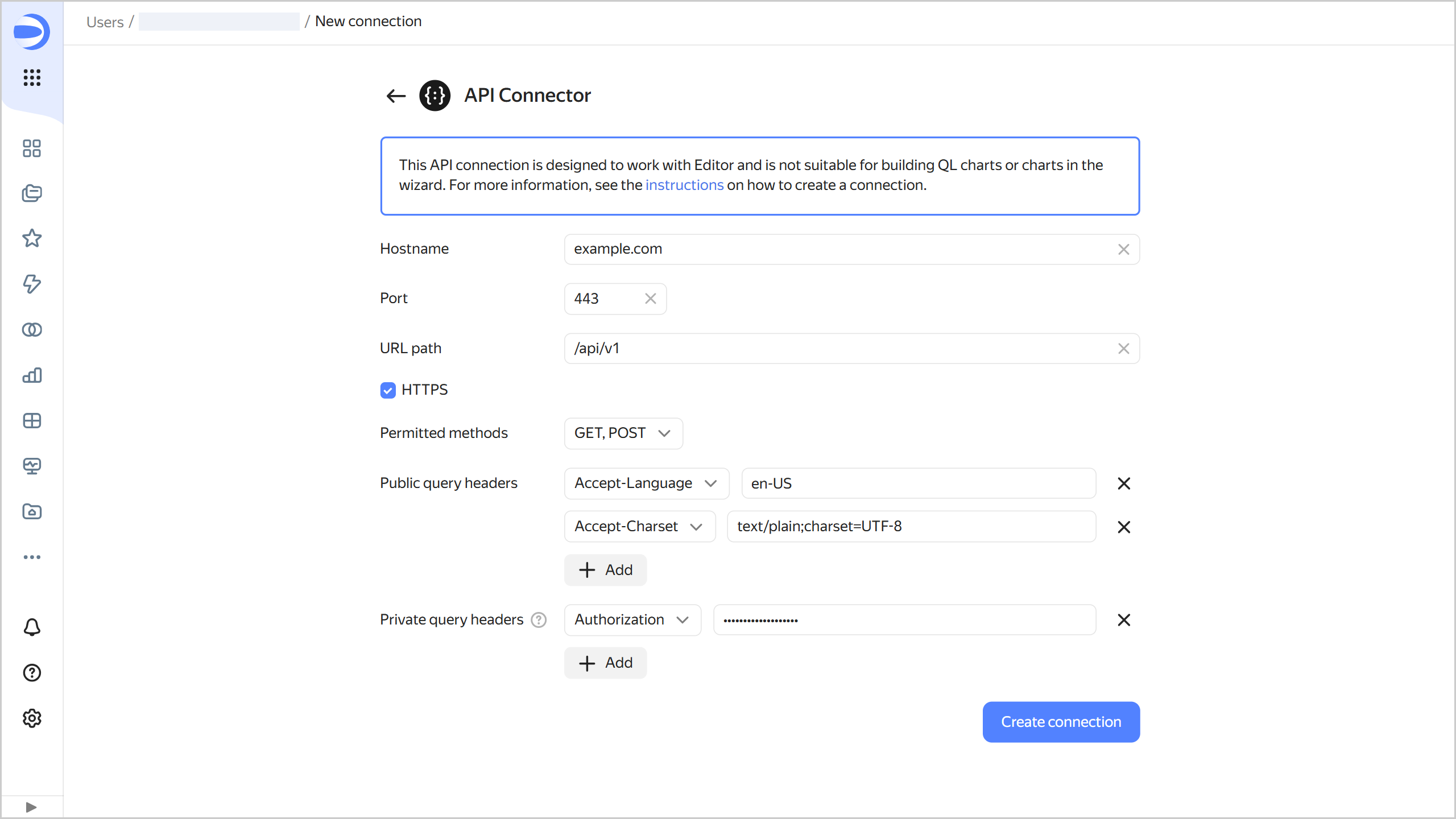
Configure the connection as follows:
-
Host name: Specify the path to the host you will send a request to.
-
Port: Specify the API connection port.
-
URL path: Optionally, specify the path to the API (part of the URL without a protocol, host name, or port).
-
HTTPS: Enable the secure connection option if your server supports HTTPS.
-
Allowed methods: Select a method to send an HTTP request to the API. The available methods are
GET,POST,PUT,PATCH, andDELETE. -
Add public and private headers to your HTTP request as key-value pairs. To do this, click Add, select the header, and enter its value.
-
Public request headers do not contain sensitive data. You can view values of public headers at any time in the connection settings. The following public headers are available:
Accept-Charset: List of supported response encodings.Accept-Encoding: List of supported response contents encoding methods.Accept-Language: List of supported natural languages.Prefer: HTTP status code to send in the response.X-Org-ID: Yandex 360 for Business organization ID.X-Cloud-Org-ID: Cloud organization ID.
-
Private request headers are used for sensitive data. Their values are encrypted; you cannot view them in the connection settings, but you can replace them with new values. The following private headers are available:
Authorization: API authentication data.X-Api-Key: API key for authentication in ClickHouse®.X-ClickHouse-User: Username for authentication in ClickHouse®.X-ClickHouse-Key: User password for authentication in ClickHouse®.
-
-
-
Click Create connection.
-
Select a workbook to save your connection to or create a new one. If using legacy folder navigation, select a folder to save the connection to. Click Create.
-
Enter a name for the connection and click Create.
Note
The API can return data in any format. This data will be processed by Editor, so make sure the Editor chart code can handle that specific format. For an example of API response processing, refer to this guide on creating a table via the API.
ClickHouse® is a registered trademark of ClickHouse, Inc.